Sunday, May 26, 2013

10 Things Charter Schools Won't Tell You

1. We're no better than public schools.
Not that public schools are perfect, as many parents know. See our earlier story, 10 Things Your School District Won t Tell You

A host of other studies on charter school outcomes have come up with sometimes contradictory results. As with traditional public schools, there are great charters and some that aren't so great. There s a lot of variation within charter schools, points out Katrina Bulkley, an associate professor of education at Montclair State University who studies issues related to school governance. In fairness to organizations that are running high-performing schools, many of them are very frustrated with the range of quality, because they feel that it taints charter schools as a whole, Bulkley says.

2. Our teachers aren t certified.
According to data from the National Center for Education Statistics, charter-school teachers are, on average, younger and less likely to hold state certification than teachers in traditional public schools. In a 2000 survey, 92% of public school teachers held state certification, compared to 79% of charter school teachers. A 2008 survey found that 32% of charter school teachers were under 30, compared to 17% of traditional public school teachers. Charter schools often recruit from organizations like Teach for America that provide non-traditional paths into the profession, and more-experienced teachers who already have jobs in traditional public schools may have little incentive to give up the protection of tenure.
Relying on relatively untrained, inexperienced staff may have a real impact in the classroom. A lot of them don t have classroom management skills, says May Taliaferrow, a charter-school parent.

3. Plus, they keep quitting.
As many as one in four charter school teachers leave every year, according to a 2007 study by Gary Miron, a professor of education at Western Michigan University, and other researchers at the Great Lakes Center for Education Research and Practice. That s about double the typical teacher turnover rate in traditional public schools. Charter schools typically pay teachers less than traditional public schools do, and require longer hours, Miron says. Meanwhile, charter school administrators earn more than their school-district counterparts, which can also make teachers feel underpaid, he says. The odds of a teacher leaving the profession altogether are 130% higher at charter schools than traditional public schools, according to a 2010 study by the National Center on School Choice at Vanderbilt University. That study also found that much of this teacher attrition was related to dissatisfaction with working conditions.
Higher turnover is inevitable with a younger staff and the ability to get rid of ineffective teachers, says Peter Murphy, a spokesman for the New York Charter Schools Association. There needs to be more turnover in district schools, Murphy says. Instead, what you have is this rigid tenure system where teachers are not held accountable, and children suffer.

4. Students with disabilities need not apply.
Six-year-old Makala was throwing regular tantrums in school, so her mother, Latrina Miley, took her for a psychiatric evaluation, eventually ending up with a district-mandated plan that stated the girl should be taught in a smaller class where half the students have special needs. The charter school s response, Miley says, was to tell her she could either change her daughter s educational plan, or change schools. She moved Makala to a nearby public school where, she says, teachers have been more effective at managing her daughter s behavior issues. The school says it can t talk about specific cases.
Critics say charter schools commonly counsel out children with disabilities. While a few charter schools are specifically designed to serve students with special needs, the rest tend to have lower proportions of students with special needs than nearby public schools, according to a review of multiple studies conducted by the University of Colorado s Education and the Public Interest Center. Charter schools also appear to end up with students whose disabilities are less expensive to manage than those of public school students. A Boston study, conducted by the Massachusetts Teachers Association, found that 91% of students with disabilities in the city s charter schools were able to be fully included in standard classrooms, compared to only 33% of students with disabilities in the traditional public schools.

5. Separation of church and state? We found a loophole.
Charter schools are public schools, supported by public tax dollars. But among the thousands of charters nationwide are schools run by Christian organizations as well as Hebrew and Arabic language academies that blur the line between church and state. What would not be tolerated in a regular public school seems to be tolerated when it s a charter school, says Diane Ravitch, a professor of education at New York University and the author of The Death and Life of the Great American School System. Even if these schools aren't explicitly teaching religion, it s potentially segregation by religious preference, Bulkley says.

6. We don t need to tell you where your tax dollars are going.
An investigation by Philadelphia s City Controller earlier this year uncovered widespread financial mismanagement among the city s charter schools, including undisclosed related party transactions where friends and family of school management were paid for various services, people listed as working full time at more than one school, individuals writing checks to themselves, and even a $30,000 bill from a beach resort charged to a school.
Financial scandals have come to light in schools around the country, but what s more troubling, says advocate Leonie Haimson of Class Size Matters in New York City, is that charter schools have opposed state audits of their finances. The New York Charter School Association won a lawsuit against the state comptroller last year, with the court ruling that the legislature had violated the state constitution when it directed the comptroller to audit charter schools. Charter schools in the state are already overseen and audited by at least two other agencies, Murphy says. We have never objected to being audited, being overseen, and being held accountable. In fact, this organization has come out in favor of closing low-performing charter schools, he says.

7. We ll do anything to recruit more kids
Walking around New York City, it s impossible to miss the ads on buses and subways for the Harlem Success academies, Haimson says. The school is legally required to reach out to at-risk students, and it has been opening new schools over the past couple of years. However, some schools elsewhere have gone beyond marketing. A charter school in Colorado gave out gift cards to families that recruited new students, and another school in Louisiana gave out cash.

8. but we ll push them out if they don t perform.
The Knowledge is Power Program (KIPP) schools have been criticized for high rates of student attrition, in part because it s the struggling students who are more likely to leave schools mid-year so if more students leave charters, that churn could boost a school's scores. A KIPP study released in June found students leaving at rates comparable to the rate at which students leave traditional public schools but, according to Miron, that study ignored the fact that KIPP schools don t then fill empty slots with other weak, transient students the way traditional public schools do. Traditional public schools have to take everybody, Miron explains. Charter schools can determine the number they want to take and when they want to take them, and then they can close the door.
Miron found there was a 19% drop in enrollment in KIPP schools from grades 6 to 7, and a 24% drop from grades 7 to 8. Some charter schools lose 50% of a cohort each year, Miron says. And in some cases, students can be explicitly pushed out of a charter school for failing to meet the school s academic or behavioral standards an option that s not available to a traditional public school.

9. Success can be bought.
Some of the most successful charter schools are also some of the wealthiest. Harlem Children s Zone, for example, had over $193 million in net assets at the end of the 2008-2009 school year, according to its most recent IRS filing. The organization s charter schools spend $12,443 per student in public money and an additional $3,482 that comes from private fundraising. That additional funding helps pay for 30% more time in class, according to Marty Lipp, spokesman for the organization.
It s great to see schools that have the resources to spend lavishly to help children succeed, Bulkley says, but it's difficult to see how those schools can then be models for traditional public schools largely constrained by traditional public budgets. All schools should get what they need, Lipp says, but adds, You give two people $10 and they spend it different ways, so it s not simply about money.

10. Even great teachers can only do so much.
Much of the public debate over charter schools focuses on teacher performance and the ability to fire ineffective teachers something that s more difficult at a traditional public school where teachers are typically union members. While it's true that teachers represent the most important in-school factor affecting student performance, out-of-school factors matter more, Ravitch says. The single biggest predictor of student performance is family income, she says. I certainly wish it were not so, but it is. Children from higher-income families get a huge head start thanks to better nutrition, a larger vocabulary spoken at home and other factors, she says. The narrative that blames teachers for problems that are rooted in poverty is demoralizing teachers by the thousands, Ravitch says. And you don t improve education by demoralizing the people who have to do the work every day.


Education Reform in the New Jim Crow Era 

Click here to view an interview with P.L. Thomas

By P.L. Thomas, Truthout | Op-Ed
OFFICERS SCHOOLS CRIME 7 mainOfficer Craig Davis, a former municipal policeman now with the Houston school district force, monitors a hallway at E.L. Furr High School in Houston, March 20, 2013. (Photo: Michael Stravato / The New York Times) 
There are significant parallels between the war on drugs and market-oriented education reform, and both create an underclass - especially among African American males, according to Thomas, who traces the history.

In the United States, the intersection of the criminal justice system and public schools has intensified in the wake of school shootings, prompting similar solutions from supposedly opposite ends of the political spectrum. As noted in a New York Times editorial,  "The National Rifle Association and President Obama responded to the Newtown, Conn., shootings by recommending that more police officers be placed in the nation's schools."

As the editorial points out, however, research tends to show that police in the hallways  creates schools-as-prisons and students-as-criminals, increasing, rather than eliminating, the problems. In another piece, Chloe Angyal highlights the disturbing connection between incarceration and education:
Punishment rates in schools mirror the rates in the 'real world' - though what could be more real than entrenched discrimination in our schools? - and in fact, contribute to those real world figures. The Civil Rights Project report notes that the abuse and misuse of suspensions can turn them into "gateways to prison." Even if that were not the case, even absent a school-to-prison pipeline, the situation would be grim enough. What this report reveals is a disregard for the well-being of marginalized populations that, were it directed at other groups, would never be allowed to stand. If a quarter of white middle school boys were being suspended every school year, and if pretty white ladies were being frisked on the streets of Manhattan, there'd be an uproar.
While the term "a nation at risk" tends to be associated with the 1983 report on US education from the Reagan administration, the early 1980s also spawned an era of mass incarceration, built on claims that the United States was also a nation at risk because of illegal drug sales and use, identified by author Michelle Alexander as The New Jim Crow:
In October 1982, President Reagan officially announced his administration's "War on Drugs. At the time he declared this new war, less than 2 percent of the American public viewed drugs as the most important issue facing the country. This fact was no deterrent to Reagan, for the drug war from the outset had little to do with public concern about drugs and much to do with public concern about race. By waging a war on drug users and drug dealers, Reagan made good on his promise to crack down on the racially defined "others" - the undeserving. (p. 49)
Within a year of each other, then, the Reagan administration launched a war on drugs and a crisis response to public education. Just as Alexander details the masked intent behind the war on drugs, John Holton exposed A Nation at Risk as less about education reform and more about political agendas.
We met with President Reagan at the White House, who at first was jovial, charming, and full of funny stories, but then turned serious when he gave us our marching orders. He told us that our report should focus on five fundamental points that would bring excellence to education: Bring God back into the classroom; encourage tuition tax credits for families using private schools; support vouchers; leave the primary responsibility for education to parents; and please abolish that abomination, the Department of Education. Or, at least, don't ask to waste more federal money on education - "We have put in more only to wind up with less."
For three decades, the War on Drugs has led to mass incarceration, primarily impacting African American males, the racially defined "others," and the education reform movement based on high-stakes accountability has targeted "other people's children"  in ways that suggest market-oriented education reform is a school-based component of the New Jim Crow grounded in the criminal justice system.

Mass incarceration and market-oriented education reform share more than their genesis in the 1980s, since both have been shown to cause far more harm than good and to further marginalize African American and impoverished youths and adults.

The Dark Reality of Market-Oriented Education Reform
The education accountability era begun in the early 1980s focused on implementing curriculum standards and high-stakes testing, first at the state level and then over the decade since No Child Left Behind (NCLB), increasingly at the national level.

The evolution of the education reform movement has included some central ideological commitments - focusing on in-school-only reform and relying on slogans such as "no excuses" and "poverty is not destiny," as expressed in a 2010 manifesto from several key figures in reform, Michelle Rhee, Paul Vallas and Joel Klein:
So, where do we start? With the basics. As President Obama has emphasized, the single most important factor determining whether students succeed in school is not the color of their skin or their ZIP code or even their parents' income - it is the quality of their teacher.

Yet, for too long, we have let teacher hiring and retention be determined by archaic rules involving seniority and academic credentials. The widespread policy of "last in, first out" (the teacher with the least seniority is the first to go when cuts have to be made) makes it harder to hold on to new, enthusiastic educators and ignores the one thing that should matter most: performance.
At first, reform was driven by revolutionary promises and often unverified claims of public school failure, but over the past 30 years, ample evidence now suggests that political education reform has failed to fulfill its promises, and, in a mechanism similar to the negative consequences of the mass incarceration, has harmed the exact students those reforms were designed to help.

The Broader, Bolder Approach to Education has resisted market-oriented, in-school-only reform championed by Secretary of Education Arne Duncan, Bill Gates, Rhee, Vallas and Klein, calling instead for social and educational reform seeking equity of opportunity for all families and students. In Broader, Bolder's "Market-Oriented Education Reforms' Rhetoric Trumps Reality" (April 18, 2013), Elaine Weiss and Don Long examine test-based teacher evaluations, school closures and expanded charter schools in Chicago, New York City and Washington, DC, concluding: "The report finds that the reforms delivered few benefits and in some cases harmed the students they purport to help. It also identifies a set of largely neglected policies with real promise to weaken the poverty-education link, if they receive some of the attention and resources now targeted to the touted reforms." (p. 3)

Market-oriented education reform has depended on addressing inequity indirectly, trusting mechanisms such as choice and business models of managing teachers as well as schools to initiate social change. This reform has specifically targeted goals such as closing the achievement gap, better serving impoverished and minority students, and raising international indicators of educational quality.

As Weiss and Long show, however, test-based teacher evaluations, school closures and expanded charter schools haven't succeeded, even against their advocates' promises:
· Test scores increased less, and achievement gaps grew more, in "reform" cities than in other urban districts.
· Reported successes for targeted students evaporated upon closer examination.
· Test-based accountability prompted churn that thinned the ranks of experienced teachers, but not necessarily bad teachers.
· School closures did not send students to better schools or save school districts money.
· Charter schools further disrupted the districts while providing mixed benefits, particularly for the highest-needs students.
· Emphasis on the widely touted market-oriented reforms drew attention and resources from initiatives with greater promise.
· The reforms missed a critical factor driving achievement gaps: the influence of poverty on academic performance.
· Real, sustained change requires strategies that are more realistic, patient and multipronged. (p. 3)
Further, additional evidence reveals (ostensibly) unintended consequences of market-oriented reform have included increased segregation by race and class in charter schools and a widening gap between the type of educational experiences affluent children receive compared with the authoritarian and test-prep-focused "no excuses" schools for minority and impoverished students, notably as detailed in Sarah Carr's Hope Against Hope, exploring the post-Katrina rise of charter schools in New Orleans:
But inside the schools, the war over education no longer seems so stark and clearly defined. Edges blur, shades of gray abound, and simple solutions prove elusive.  . . . Many of the most powerful people in the country have a plan for the future of education in America, one focused on more charter schools, technocratic governance, weakened teachers' unions and the relentless use of data to measure student and teacher progress. (pp. 5, 6-7)
But Carr's narrative and analysis show that, as detailed in the Broader, Bolder report, market-oriented reform tends to replicate and even perpetuate inequity instead of eradicating it: Students in New Orleans sit in "no excuses" charter schools that are both authoritarian and segregated, while the post-Katrina Recovery District reduced the African American teacher workforce from 75 percent to 57 percent of the city's teachers.

Despite the slogans and the rhetoric, schools experiencing the array of market-oriented education reform policies have shown that home and community characteristics do predict educational opportunities, mirroring the historically greatest challenge facing traditional public schools. Ultimately, like the War on Drugs, current education reform exists as a key element in America's New Jim Crow era.

Education Reform and "Racially Sanitized Rhetoric"
Just as the education reform movement was spurred by a "manufactured crisis,"  as exposed by Gerald Bracey and Holton, the War on Drugs grew out of a racially divisive political agenda, a drug crisis that did not yet exist, but created "mass incarceration in the United States . . . as a stunningly comprehensive and well-designed system of racialized social control that functions in a manner strikingly similar to Jim Crow," as Alexander details. (p. 4)

Since market-oriented education reform is producing evidence highlighting the ineffectiveness and even negative outcomes associated with those policies, that the agendas remain robust suggests, again like mass incarceration, education reform fulfills many of the dynamics found in the New Jim Crow.
Just as mass incarceration from the war on drugs continues institutional racism once found in slavery and Jim Crow, education reform, especially the "no excuses" charter school movement, resurrects a separate but equal education system that is separate, but certainly isn't equal. The masked racism of mass incarceration and education reform share many parallels, including the following:

· Both depend on "racially sanitized rhetoric," according to Alexander, that thinly masks racism. "Getting tough on crime" justifies disproportional arrests, convictions and sentencing for African Americans; "no excuses" and "zero tolerance" justify highly authoritarian and punitive schools disproportionally serving high-poverty children of color.

· Both depend on claims of objective mechanisms - laws for the war on drugs and test scores for education reform - to deflect charges of racism. Alexander recognizes "this system is better designed to create [emphasis in original] crime and a perpetual class of people labeled criminals, rather than to eliminate crime or reduce the number of criminals," (p. 236) just as test-based education reform creates and does not address the achievement gap.

· Both depend on racialized fears among poor and working-class whites, which Alexander identifies in the Reagan drug war agenda: "In his campaign for the presidency, Reagan mastered the 'excision of the language of race from conservative public discourse' and thus built on the success of the earlier conservatives who developed a strategy of exploiting racial hostility or resentment for political gain without making explicit reference to race" (p. 48). The charter school movement masks segregation within a progressive-friendly public school choice.

· Both depend on either current claims of post-racial America or the goal of a post-racial society: "This system of control depends far more on racial indifference [emphasis in original] . . . than racial hostility," Alexander notes. (p. 203
· Both depend on a bipartisan and popular commitment to seemingly obvious goals of crime eradication and world-class schools.
· Both depend on the appearance of African American support. Alexander explains about the effectiveness of the war on drugs: "Conservatives could point to black support for highly punitive approaches to dealing with the problems of the urban poor as 'proof' that race had nothing to do with their 'law and order' agenda." (p. 42

This last point - that African Americans seem to support both the war on crime and "no excuses" charter schools - presents the most problematic aspect of charges that mass incarceration and education reform are ultimately racist, significant contributions to the New Jim Crow.

For example, Carr reports that African American parents not only choose "no excuses" charter schools in New Orleans, but also actively cheer and encourage the authoritarian policies voiced by the schools' administrators. But Alexander states, "Given the dilemma facing poor black communities, it is inaccurate to say that black people 'support' mass incarceration or 'get-tough' policies" because "if the only choice that is offered blacks is rampant crime or more prisons, the predictable (and understandable) answer will be 'more prisons.' " (p. 210)

New Orleans serves as a stark example of how this dynamic works in education reform: Given the choice between segregated, underfunded and deteriorating public schools and "no excuses" charters - and not the choice of the school environments and offerings found in many elite private schools - the predictable answer is "no excuses" charters.

Market-oriented education reform continues to produce evidence that it fails against its own goals and standards. But more disturbing is that current education reform also shares with the war on drugs evidence that the United States is committed to the New Jim Crow, to which Alexander quotes Martin Luther King Jr.: "Nothing in all the world is more dangerous than sincere ignorance and conscientious stupidity." (p. 203)

The war on drugs and highly punitive, segregated charter schools are creating an underclass, significantly among African American males - facts that must be acknowledged before equity of opportunity can be secured. About this intersection of the criminal justice system and education reform, Angyal asks, "But the real question is, what will it take for us to fix this system that punishes students and citizens for no other reason but their membership in marginalized groups?"

Friday, May 24, 2013

Schumpeter: Creative destruction and imposing markets in education

by mches

 
I’ve taken a decidedly more strident tone as of late, so I want to spend some time examining why this is so.  It’s not that TFA or education reform as a whole has changed much in the last couple of years, but my analysis of it certainly has.  The longer I spend in the classroom, the greater emphasis I place on the importance of relationships and community and care.  I tend to think of these as values which often run afoul of the values of the economic elite like austerity, efficiency, or being data-driven.  I see the former group as necessary tools of being an educator and the latter as the tools of an economist.

What I’ve done with this post is explore the conflict behind the corporate reformers and the educators they seek to impose their will over.  In it, I hope to prove that the aims of corporate reformers and those of educators are necessarily at odds with one another.

Introduction to Market-Based Reformers

The corporate reform movement is an attempt by a group of wealthy philanthropists to impose market forces where there had previously been none or had protections against them.  The policy instruments they support are: 
  1. data-driven management designed to weed out undesirable employees and reward superstars; school choice models,
  2. designed to foster competition for student enrollment and their tax dollars to bring down costs and improve customer satisfaction, and
  3. weakening teacher unions to allow for greater labor market flexibility.

This tribe of reformers resolves that market-oriented reforms will offer a better, more varied and customer-pleasing product.  Or, it will deliver at least the same quality of product for less money.  And, in doing so, these reforms will yield a more equitable education for children in low-income households because parents will not be forced to send their kids to the substandard schools available in their neighborhood.

The Intentionality of Disruption
The argument that such reforms will be disruptive, lead to job loss, would cause total havoc to the education system as a whole falls on deaf ears.  One of the staggering capabilities of markets is their capacity for creative destruction, a term popularized by the economist Joseph Schumpeter.  Because of the efficiency of markets to adapt to consumer demands, the products, services, and firms of one era will almost certainly fall prey to the changing needs of the markets.

 One company rises (Microsoft), another falls (IBM).  An innovation captures the imaginations of millions one generation only to crumble mere decades later (Polaroid).  This is good for us because we reap the benefits of this relentless creative thrust.  Things get better, faster, and cheaper, and our lives are made easier and more fun.

For market-based reformers, the destruction of public education is not a bug; it’s a feature.  Like a phoenix out of the ashes, a new, robust, monetized educational system is something to be desired so that — finally — schools can harness the awesome power of private markets.

In order for markets to work and not descend into some corporatist public-private hybrid, the role of the entrepreneur is essential.  They are the risk-takers.  They strategically gamble on the novelty of their ideas, on the notion that there is a group of people out there who want what they can provide and that no one else is providing what they’ve got.  In the last half-century, these are the Gates, Jobs, and Zuckerbergs of the world, risking the security of a sure-thing job at an established firm for the possibility of striking gold on your own.  This risk is what makes innovation possible and is what drives the dynamism of markets.

My question is this: are the roles of educator and entrepreneur mutually compatible?  Can one be both risk-taker and caretaker?

Risk-taker v. Caretaker
As a caretaker, I value stability, engendering trust, meeting the needs of someone else before my own, and cooperation.  The risk-taker values reward, self-interest, recognition, and accomplishment.  I think a Venn diagram between the two roles would show an intersection for things like cooperation, recognition, and accomplishment.  But I think of cooperation as an end for the caretaker and a means to an end for a risk-taker.  For accomplishment and recognition, it’s vice versa.  My interest in personal accomplishment is a means to the end of improving the lives of my students.

I feel that the corporate reform movement doesn’t value things like trust or stability or meeting others’ needs because they are very difficult to quantify.  Note the reforms they support in the introduction: employee management based on test data, competition in school markets, labor flexibility.  All of these things can be measured using dollars, student enrollment numbers, or standardized test data.

How do I know my school is successful?  The caretaker will talk to you about conversations they have had with parents and students, the sense of joy and love they have in their work, the great progress their students have made towards adulthood which may or may not be college-focused.  The risk-taker will point to their numbers: test scores went up, student enrollment went up, revenues went up.

This poses an interesting challenge for the market-based approach to schools.  If we measure schools on their metrics alone, where do we find the market winners and losers?  In other words, where are the good schools and bad schools in a market system?

Good schools v. Bad schools
Let’s take a look at students who move frequently versus those who stay put in one location.  The creative destruction of markets means schools will open and close with fluidity.  The bad ones won’t have enough customers, the good ones will open up more campuses or expand existing ones to meet consumer demand.  There will be students who find themselves in the middle of this tumult more so than others.  Those students will also be bouncing between teachers and their different teaching styles, perhaps different curricula, different sets of rules and consequences, different peers and friends(4).  Because the schools don’t have to keep them, kids with behavior challenges will bounce more than anyone.  The public schools will become the last bastion for these students and others with special needs.  Those who have a stable school home will have better social and better academic outcomes and these will often be the children of parents who can afford the “good” schools much like the parents who can afford “nice” homes today.

My guess is the “bad schools” in the market will often be located near the “bad schools” of today.  This is because the supposed goodness or badness of schools has less to do with the staff or administration or innovations like long hours and days and years, or with some magical properties of the school building itself.  No, school quality comes down to peer effects.  This is how it works when we describe “nice” neighborhoods or churches or grocery stores.  You want to know what makes the “nice” HEB so nice, why the store is cleaner, why it offers a greater diversity of products that are healthier than the HEB down the street from my school?  Give me a minute…do you think it’s because its customer base is wealthier?  You mean, it’s not because the store managers or cashiers are less capable or because the west side HEB patrons just aren’t motivated enough to want 75 varieties of hummus(5)?  Of course not.  This is just the market at work.  The market doesn’t care about equity, period.  The market responds to the demands of its consumers.

Contrary to the wishful thinking of education reformer grandpappy Milton Friedman, if the market demands even more segregation than is currently available in government schools, then so be it(6).

If a neighborhood has “bad schools,” they’ll just have to adapt by getting rid of low-performing teachers and students until they are good.  And those low performers will be thrust back into the marketplace to find a new home, even though every other school will succumb to the same pressures.  The public school will necessarily become the dumping ground for the most challenging or expensive to teach students.

Contrary to the theoretical model put forth by free-market ideologues, markets do not yield more equitable results.  The gulf between the “good” and “bad” schools widens because of the inherent segregating properties of market forces.

A Cost-Benefit Analysis of Creative Destruction in Education
Let’s think about what is lost in this creative destruction.
  • First and foremost, kids lose.  Since charters are not public schools, they will lose their constitutional rights.  Many more kids will lose art, physical education, music, journalism, debate, dance, creative writing, a variety of foreign languages, and any other class that is not tested, not considered “essential.”  Students will profound special needs will be further segregated from non-disabled peers because so few schools will want to take on the additional responsibility.  Students with language needs will languish trying to find a school that will take them and meet their needs appropriately.

  • Parents lose their voice.  They are granted a voice as customers, but this is illusory.  They are subject to the availability of what the market provides.  If they are dissatisfied, they move to another school.  This is rough on the kid and on the parents who now have to shop for this other school, possibly in a neighborhood they of their child can’t get to easily.  If the school is not satisfied with the student, the student can be booted out in spite of parental protest.

  • Teachers lose their voice.  As labor participants, we are given a choice of where we want to work, but without organized labor to speak on behalf of workers, the market will dictate wages and hours.  The private school, either for-profit or not, will have incentive to remain competitive, trimming the fat wherever possible.  The bulk of a school’s operating cost goes to personnel.  This means teachers get their salaries cut and their hours extended.  And when that happens, it’s our fault because these are the schools we chose to work in.  This is what we signed up for.
I don’t want to suggest that no one would gain from such a system.  Parents of certain religious inclinations would now have government funds to send their children to parochial schools, and market reforms would certainly aid those parents who wish to include a spiritual element to their child’s curriculum.  However, there’s the whole separation of church and state thing to worry about, not to mention the lunatics who teach creationism as science.  With vouchers, parents who already send their kids to private schools now have a subsidy to do so.  So it’s regressively redistributive, but hey, rich people get harangued all the time, isn’t it time they got a break?  And, let’s not forget the windfall of business opportunities for-profit endeavors would have access to(7).
The Future of Education Reform
How should we proceed then, as caretakers or risk-takers?  What do we value in schools and from teachers?  It is my view now that these roles are inherently opposed to each other.  If we are to seek equity, social justice, and equality of opportunity for children of lesser means, then we should reject the suggestions and impositions of the corporate reform movement steadfastly.  We ought to limit the influence of misleading or useless metrics such as census standardized test scores and recognize the folly of competitive markets when what is at risk is not mere capital but human beings with complex lives.  We ought to push for reforms that empower all families to be involved in their children’s education and success in schools, that seek a level playing field, that work to integrate all walks of life into a community of equals.

The risks are too great to pursue the destructive ends a market will wreak.  The stakes are far too high to pursue anything less than equity for our kids.

NOTES
(1) Charters schools and voucher programs.
(2) Ostensibly parents and children.
(3) Including, but not limited to, diminishing or eliminating the importance or necessity of licensure.  Hence preferences for TFA, alternative certification programs, and charters, all of which circumvent the market artifice of traditional teacher certification.
(4) Assuming the gubmint keeps their dirty hands off standards altogether.  Oops, sorry libertarians, this one is not coming close to happening.
(5) DING DING DING!  For getting this question correctly, you get a buy-one-get-one-free coupon for Pita Pal-brand hummus.
(6) The late free-market guru Milton Friedman fretted that no true universal voucher program had ever been instituted in the United States and therefore no real reform would occur.  He also believed that such a voucher system would allow parents to get their kids out of low-performing schools and improve the education of those students.  Well, Chile has had a universal voucher system and, quelle surprise, the vouchers have “exacerbated segregation between schools and between types of schools.”
(7) To be denied decades of government largesse only to suddenly be afforded access to millions of kids with shiny golden tickets in their hands worth $5000 a piece…you know the investment world is salivating at the opportunity.

Thursday, May 23, 2013

SCHOOL CLOSING QUOTABLES


Trumbull Local Schools Council member Ali Burke hugs Wendy Kattan of Raise Your Hand following the board of education's vote to close 50 Chicago Public School, May 22, 2013. | Jessica Koscielniak ~ Sun-Times
Sun-Times headline
In less time than it takes to boil an egg -- This morning
Columnist Mark Brown
In the end, the board was so tone deaf to its audience that on the crucial vote that closed most of the schools, they used the parliamentary maneuver of adopting the previous favorable roll call — instead of taking the extra 30 seconds to each say “yes” once more. The average person in attendance didn’t even know the closings had been approved until it was over. -- "CPS closings vote shows it’s time for an elected school board"

Whitney Young students hold vigil. (Sun-Times)
Prof. Mark Naison
One key component of this strategy is demographic inversion- moving the poor out of the center city into the periphery, where they will no longer be able to physically or politically threaten the global elites who will be working and playing in the redeveloped Center. This process is already well under way in cities like New York, Chicago, Washington and Milwaukee- with the result being that more poor people now live in suburbs than in cities...
 ... "Erasing History In Chicago and Other Places"
Prof. Federico Waitoller, Dept. of Special Ed, UIC 
This combination of factors will make school closings doubly hard for students of color with special needs. The sheer magnitude and speed of these changes will be especially painful for what is already the school district’s most vulnerable population. -- Letter to Tribune
Sports writer Dave Zirin
 It all starts with the person who seems committed to win the current spirited competition as the most loathsome person in American political life: Mayor Rahm Emanuel. The same Mayor overseeing the closing of fifty-four schools and six community mental health clinics under the justification of a “budgetary crisis” has announced that the city will be handing over more than $100 million to DePaul University for a new basketball arena. -- The Nation

Apple's Tax Hypocrisy,

Alec MacGillis, New Republic, May 23, 2013

It’s remarkable how quickly the storm of outrage over Apple’s epic tax avoidance has passed over Washington. All it took was for Apple CEO Tim Cook (2011 compensation: $378 million) to share some yuks with senators about their love for his company’s products (“I love Apple. I love Apple,” enthused Claire McCaskill) and to cast Apple’s extreme measures to avoid taxes (paying not a cent on $30 billion in global profits parked in an Irish subsidiary that has as much physical reality as a leprechaun) as a mere matter of subjective perspective: “The way that I look at this is there’s no shifting going on that I see at all,” Cook told John McCain. “I see this differently than you do, I believe.”

There’s one aspect of the Apple tax avoidance that I’m particularly surprised has been allowed to slip unscrutinized. As you’re probably aware, the Silicon Valley giants have been in Washington a lot of late for something other than explaining the postmodern relativism of tax liability: to lobby for immigration reform. They're interested, in particular, in greatly expanding the number of H-1B visas, which Apple, Google, Facebook and the rest of the tech behemoths rely on to hire foreign software engineers. They need to bring these workers over from India, China and elsewhere, the companies say, because there simply aren’t enough qualified native ones being trained here at home. One of the biggest champions of this demand was none other than Steve Jobs, Cook's predecessor, who made the pitch directly to President Obama in 2011. Sometimes, the companies phrase it euphemistically: The lack of H-1B visas, Google’s public policy shop explains, is “preventing tech companies from recruiting some of the world’s brightest minds.” Mark Zuckerberg was slightly more candid in his big Washington Post op-ed, throwing his weight behind immigration reform: “To lead the world in this new economy, we need the most talented and hardest-working people” (you hear that, Middle America?) And sometimes it comes out just plain awkward: “There are simply more smart Indians and Chinese than there are Americans,” Google CEO Eric Schmidt said over the weekend on CNN. (Yes, he is of course literally correct, sample size and all—there are more dumb people over there too!—but still…)
We’ve become so used to hearing our educational system disparaged from all corners that we have insufficiently zeroed in on this part of the Silicon Valley argument. There are many reasons why our schools fall far short of the ideal—students arriving unprepared, bureaucracies constrained by hidebound rules, etc. And one reason is, yes, inadequate resources, more in some parts of the country than others. Which brings us to Apple. From the deeply-reported New York Times story that laid bare its tax avoidance last year:

A mile and a half from Apple's Cupertino headquarters is De Anza College, a community college that Steve Wozniak, one of Apple's founders, attended from 1969 to 1974. Because of California's state budget crisis, De Anza has cut more than a thousand courses and 8 percent of its faculty since 2008. Now, De Anza faces a budget gap so large that it is confronting a ''death spiral,'' the school's president, Brian Murphy, wrote to the faculty in January. Apple, of course, is not responsible for the state's financial shortfall, which has numerous causes. But the company's tax policies are seen by officials like Mr. Murphy as symptomatic of why the crisis exists.

''I just don't understand it,'' he said in an interview. ''I'll bet every person at Apple has a connection to De Anza. Their kids swim in our pool. Their cousins take classes here. They drive past it every day, for Pete's sake. ''But then they do everything they can to pay as few taxes as possible.''

As that piece reported, Apple not only does its utmost to avoid paying federal taxes in the U.S., but also to minimize its taxes at the state and local level. One favorite trick: Nevada. The Times: “With a handful of employees in a small office here in Reno, Apple has done something central to its corporate strategy: it has avoided millions of dollars in taxes in California and 20 other states. Apple’s headquarters are in Cupertino, Calif. By putting an office in Reno, just 200 miles away, to collect and invest the company’s profits, Apple sidesteps state income taxes on some of those gains. California’s corporate tax rate is 8.84 percent. Nevada’s? Zero.”

If Apple really cares about a shortage of homegrown engineering talent, then it should pay taxes to fund the institutions that could address that problem. Yes, I know. What they've done in seeking out every loophole from Eire to eternity is technically legal. It’s the fault of the governments that allow these loopholes to exist. Everyone does it. But here’s why these rationalizations don’t cut it any more, if they ever did. In taking such an influential role in shaping our new immigration policy, the Silicon Valley giants are offering themselves as having a stake in our country’s common prosperity: To thrive, they are saying, we Americans must fix this immigration morass, by, among other things, making it easier for us to hire labor from abroad. There will be winners and losers, but it will be good for us all in the long run.

The industry’s new aspiration to a kind of town-father, old-fashioned Chamber of Commerce investment in the greater good comes through in George Packer’s terrific new New Yorker dispatch from Silicon Valley. Packer cites the scene of Obama’s 2011 visit to the Valley in Walter Isaacson’s biography of Jobs: Cisco CEO John Chambers “kept pushing [Obama] for a tax holiday on overseas profits that are reinvested in the United States…While Chambers was lobbying Obama, over cod and lentil salad, Zuckerberg turned to Valerie Jarrett, the President’s adviser, and whispered, ‘We should be talking about what’s important to the country. Why is he just talking about what’s good for him?” Packer also quotes Joe Green, a Zuckerberg roommate at Harvard who was not part of the original Facebook team but has since reunited with him to run the new Silicon Valley group, FWD.us, that is pushing immigration reform. “How do we move America into the knowledge economy? And how do we create a voice for the knowledge community that is about the future and not selfish?”

FWD.us has already run into some murky controversies as it tries to navigate the realities of partisan Washington. But the larger question raised by the industry’s new aspiration to playing a constructive role is pretty simple: Isn’t one way to show that you want to be part of the nation’s common good—a “not selfish voice”—to, you know, pay taxes? Or rather, not go completely out of your way to avoid paying them? Yes, companies have a fiduciary responsibility to their shareholders to grow profits. But in their quest to reform immigration laws to their liking, the Valley giants are arguing that there is some sort of commonwealth that will, in the end, benefit our entire bottom line—corporate and national. Why does the same logic not apply at all when it comes to their tax liability? Why can the case not be made to shareholders that it would be good for Apple in the long run if that community college just down the road from the company’s main campus (a campus that is about to be transformed into a $5 billion fortress) were not falling apart? Who knows, it might even produce a homegrown employee one of these days, like that Wozniak guy.

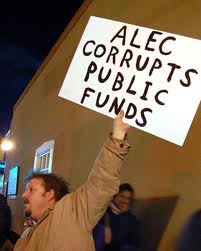
Scott Walker, GOP Slip ALEC Education Agenda Into Wisconsin Budget


Governor Scott Walker seeks to "radically" overhaul Wisconsin's education system using several pieces of American Legislative Exchange Council (ALEC) model legislation, and to do it through the budget process, meaning this privatization agenda could be enacted with minimal public discussion or debate.

Scott Walker
The proposed budget provisions have the potential to "radically change public education in the State of Wisconsin," says Julie Mead, chair of Educational Leadership and Policy Analysis at the University of Wisconsin-Madison.

On the campaign trail in 2010, Walker had pledged to "strip policy and pork projects from the state budget." But at least 46 non-budgetary items have been slipped into the proposed 2013-2015 budget, including ALEC-connected proposals limiting local school board oversight for charter schools, expanding "voucher" programs, and creating new teaching licenses for individuals with no education background.

"If these proposals have merit, they should be discussed in full light of day," she said. "They should not be snuck in through a budget bill.

The ALEC-inspired budget provisions include:

Limiting Local Control Through Expanding Charter Authorizers

One budget provision creates a "Charter School Oversight Board" that would approve nonprofit entities as independent charter school authorizers. It tracks the general ideas in the ALEC Next Generation Charter Schools Act.

Currently, only local school boards, elected by the community, can authorize a charter school; in Milwaukee, the Common Council and University of Wisconsin-Milwaukee are also authorizers.
Michael Resnick of the National School Board Association says his organization supports charters -- provided that they are approved by the local school board.

"What you want is a strong level of collaboration between the charter and school district," he told the Center for Media and Democracy, ideally with both the charter and traditional schools learning from one another. "The goal is working within the community and wanting all children to succeed."

"The local school district has a vested interest in the kids enrolled in charter schools, particularly because kids will come back into the public school system if the charter is inadequate," Resnick said. If that happens, "the public school is then held accountable for [the student's] performance, regardless of what academic disturbance might have occurred in the charter."

For Mead, another issue is accountability: both local school boards and the state superintendent are elected by the community, but independent charter school authorizers have no such accountability. "This means the publicly-funded charter schools are completely shielded from voter input," she said. 

A press release from Governor Walker's office claims the board will "preserve local control." Mead disagrees.

"There would be no local control here," Mead says. "It would wrest control from school boards, and likewise from the community that elects those school boards."

Mead also notes that, if a charter school proposal was rejected by a community and its school board, an independent authorizer could be "a defacto appellate mechanism." A charter operator could move on to the unelected independent authorizer for approval.

A similar proposal to establish a board that would directly authorize charters was introduced as a standalone bill in 2011, but failed to pass.

Expanding Taxpayer Funded Vouchers

The budget also expands the school voucher program that diverts taxpayer dollars away from public schools to subsidize private and for-profit schools, not only by increasing funding for vouchers, but also by requiring voucher programs in any district with more than two schools deemed "failing." The private school accepting the student would receive the aid for the student and the former school would lose it. This reflects the principles in the ALEC Education Accountability Act.
The proposal would immediately affect at least nine school districts, including Madison. The Madison Metropolitan School District estimates that it could lose up to $7 million in state aid once the voucher program is fully implemented.

"If we’re losing millions in state aid, we have to cut back on something,” said Madison Board of Education member Arlene Silveira. “We’ll have to reduce programming and increase class sizes,” and possibly raise property taxes to help cover the loss.

Another budget provision would provide taxpayer-funded vouchers for all students with disabilities, regardless of family income. This tracks the ALEC Special Needs Scholarship Program Act; ALEC has been tracking the passage of the bill across the country. A similar proposal was introduced as a standalone bill last session but failed to pass.

Families using a voucher might unknowingly forfeit the protections provided by the Individuals with Disabilities Education Act (IDEA), including the right to a "free, appropriate education" and an individualized lesson plan.

According to Mead, IDEA already contains an opportunity for students to get reimbursed for private school tuition, but only if they show two things: one, that the public school was substandard, and two, that the private school met IDEA's requirements for a free and appropriate education.

Under the proposed Special Needs Scholarship Program, parents would be entitled to a voucher without such a showing. And there would be little accountability for the schools accepting students under the voucher system. The Department of Education has already raised concerns about the lack of oversight for Wisconsin students with disabilities attending private schools on a regular voucher.

"The idea that we want to make special education high-quality is beyond argument. We want it to be continuously improved in the same way want all education programs improved," she said. "But how does a voucher that allows parents to exit that system, and puts kids in a private setting with no oversight, accomplish that goal?"

Mead is also concerned about the broader issue of public accountability under taxpayer-funded, privately-run voucher schools. "The Supreme Court has held that students have a constitutional right to a sound, basic education," she says. With the public system, "if that is not provided, parents can press on their policymakers to make improvements and satisfy that right."

With "choice," though, Mead is concerned that the right merely becomes "a right to shop."
"Lawmakers can claim they are absolved of responsibility to improve the system, and instead just tell parents to shop around."

Teachers Who Aren't Teachers

Another budget provision would create a new teaching license for individuals with no formal education background but subject-matter experience to teach in charter schools. This reflects the ALEC Alternative Certification Act.

"Teaching standards have evolved the way they have because research shows a high-quality teacher not only needs a background in the subject they are teaching, but also that they are schooled in pedagogy and classroom management," Mead said. "Can we find folks who have no training that can teach? Of course. But teaching standards and training have evolved as a minimum way to guarantee to public and parents what they can expect when they enroll students."

Mead also notes what she calls an "interesting juxtaposition." The legislature recently created a new educator effectiveness evaluation system, which ratchets up state oversight over teachers by creating performance criteria based on student performance and other standards. But at the same time, with this bill, Republicans are simultaneously reducing requirements for becoming a teacher
"They are lowering standards on one side while raising standards on the other," she said.

Wisconsin: Laboratory for Education Privatization

Wisconsin has long been a laboratory for the ideologically-driven school "choice" movement.
In 1990, Milwaukee was the first city in the nation to implement a school voucher program, under then-Governor (and ALEC alum) Tommy Thompson. ALEC, which had promoted vouchers since the early 1980squickly embraced the legislation. The Milwaukee-based Bradley Foundation funded the groups that laid the groundwork for Milwaukee's voucher program, and when the plan was challenged in Wisconsin courts, Bradley bankrolled its legal defense, which included hiring Kenneth Starr -- later known for pursuing Bill Clinton over Whitewater and Monica Lewinsky -- to represent the state.

Bradley is a top national funder of right-wing causes and organizations, including ALEC, and just over the past eleven years has spent over $31 million promoting "school choice" around the country, according to One Wisconsin Now. The foundation has over $600 million in assets and is headed by Michael Grebe, Scott Walker's campaign co-chair.

Originally promoted as a program for Milwaukee's low-income students of color to have access to private education, the initial voucher program gained support from some African-American leaders and was co-sponsored by Rep. Polly Williams, a Milwaukee Democrat. But last session, Walker and his fellow Republicans broadened vouchers to families with higher incomes, and in the 2013-2015 budget are threatening to further expand the program. "They have hijacked the program," Williams says. “As soon as the doors open for the low income children, they’re trampled by the high income,” she said. “It’s as if the struggle we went through 20-some years ago -- now the upper crust have taken over.”

By 2014-2015, Wisconsin taxpayers will have spent an estimated $1.8 billion sending students to private and religious schools.

School privatization interests are also major political funders in the state, spending at least $10 million in the last ten years, based on a review of political spending by the Wisconsin Democracy Campaign. Walker alone received $2.35 million in contributions and outside support from pro-privatization groups.

The total spent could actually be much higher, thanks to gaps in reporting requirements. ALEC member American Federation for Children, for example, told state officials it spent only $345,000 on the 2012 elections, but boasted to its funders it spent $2.4 million on Wisconsin legislative races. AFC got what it paid for: the top beneficiary of its spending, Rick Gudex, said he would vote against any budget bill that does not include an expansion of vouchers.

Will Radical Reform Happen Through the Budget Process?

The decades-long effort to reshape Wisconsin's public school system in an ideological mold might finally pay off this year -- and it could happen through the budget process, with minimal public input or debate.

"There is that saying, 'democracy is the worst form of government, except for all the others.' The public school system is the same way," Mead says. "It has problems, and can be better, but has served us pretty well for 150 years." 

"We shouldn't be ready to seriously alter it through the budget process, without a real conversation about whether the proposed changes will result in better systems overall."

Tuesday, May 21, 2013

12 Jobs on the Brink: Will They Evolve or Go Extinct?


Find Out If Your Job is on the Endangered Occupations List


Popular Posts